
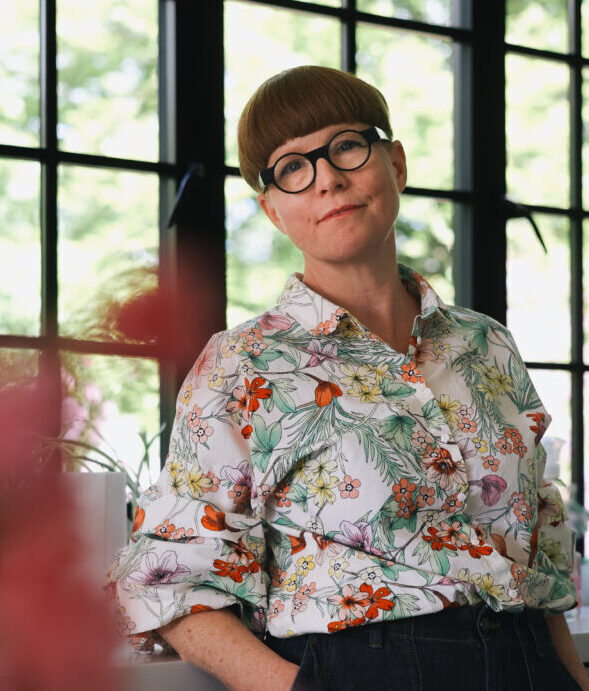
Many of the families we care for ask the same thing before meeting a celebrant for the first time: what actually happens? So we asked Beth MacLeod, an independent celebrant we work with closely, to talk it through. If anything here raises a question you’d like to explore, do contact your local funeral home. We’re here, day or night.
I’m Beth MacLeod, an independent celebrant in Sussex. Usually a family is introduced to me by their funeral director or arranger, though sometimes people find me online and approach me directly. Most families haven’t worked with a celebrant before, so I hope this helps you picture what the meeting is like.
What a funeral celebrant actually does
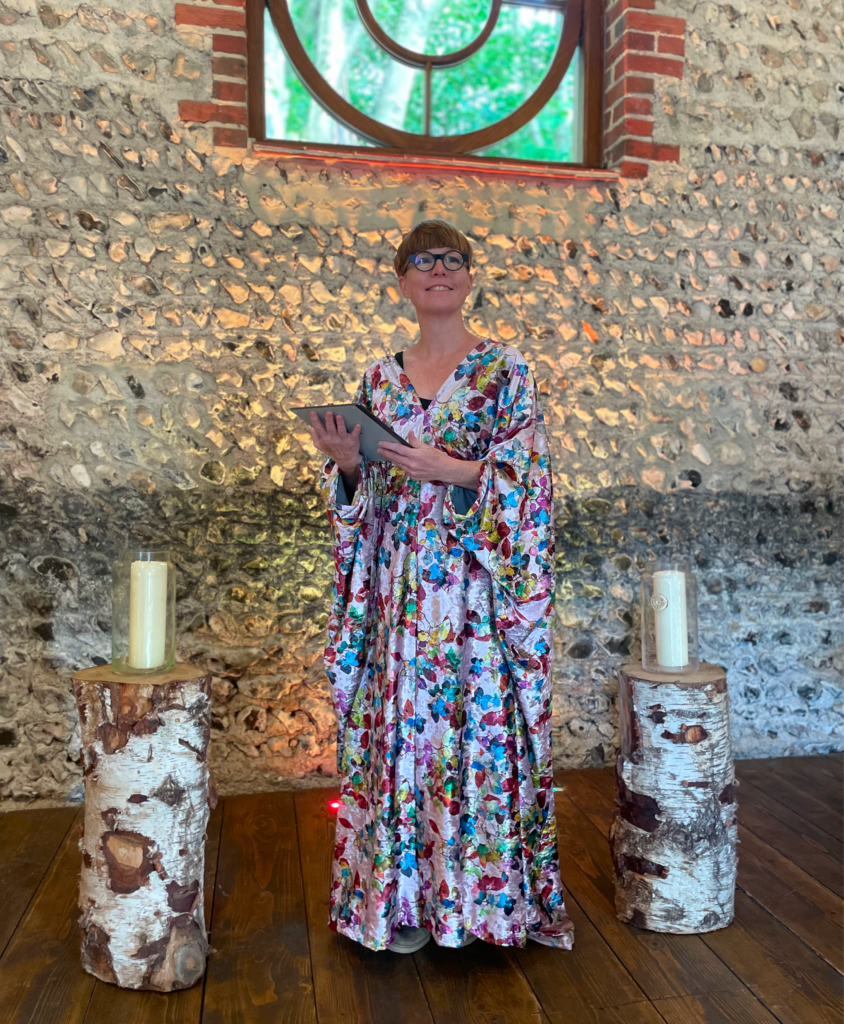
A celebrant writes and leads the ceremony. We meet the family, gather stories about the person who has died, and shape those stories into a service that reflects who they truly were. On the day, we hold the space, speak the words, and guide everyone through.
There are a few different types of celebrant in the UK, and it can help to know the difference.
Independent celebrants like me create a fully personalised ceremony, with religious or spiritual elements, or none at all, entirely as you wish.
Humanist celebrants lead non-religious ceremonies and won’t usually include prayers or hymns, which can be the right fit for a wholly secular farewell.
Civil celebrants also personalise the ceremony and can often include some religious content, such as a hymn or prayer; the differences from independent celebrants mostly come down to training and accreditation, so it’s always worth asking about a celebrant’s background.
And religious ministers, such as priests, vicars, rabbis and imams, lead ceremonies grounded in their own faith tradition.
You don’t have to use a celebrant at all, of course. Some families ask a friend or relative to lead the service instead, and a celebrant or funeral director is always happy to help that person prepare.
Where we’ll meet
The meeting usually takes place in your home, or in the home of the person who has died. If it was their home, the space tells me so much about them, which really helps. I always love to see a photograph too, so I know who we’re talking about.
If meeting at home doesn’t feel right, your funeral director can often offer a room, or we can meet somewhere neutral like a community centre. Some celebrants are happy to meet by video call as well. And please don’t worry about tidying; we’d never expect that. Though I won’t say no to a cup of tea.
Who should come along
If you can, do gather a few family members, chosen family, or close friends. Memories tend to spark one another, and the meeting becomes all the richer for it. It’s worth allowing at least a couple of hours.
That said, there’s no need for a crowd. If meeting on your own feels better, that’s completely fine too. I’ll always follow your lead.
What we’ll talk about first
I like to start by checking the practical details I already have, and confirming the date, time, and venue. Then I’ll ask a few early questions.
Did your loved one ask for anything in particular? “No black” is increasingly common these days, and so are requests for a particular colour. I led a celebration of life recently for an Irish woman where everyone wore emerald green, and I got to wear one of my favourite green dresses, and a touch like that can shift a service from sombre into something that feels truly like the person.
I’ll also ask whether your loved one was religious, spiritual, or neither, and whether there are any cultural traditions you’d like to include.
There are no right or wrong answers to any of this. I’m simply asking so I can create something that feels right for you and them.
Music, readings, and the shape of the ceremony
The question I’m asked most often is, “what do other people do?” The honest answer is that there really are no rules, and you can do whatever feels right. If the funeral is at a crematorium with a set time slot, the usual shape includes entrance music, exit music, and often a piece of reflection music in the middle, sometimes set to photographs. Many crematoriums now offer visual tributes, a sequence of photos shown on screen during a piece of music, which families often find very moving; your funeral director can tell you which local venues offer this.
A few thoughts. If your loved one wasn’t religious, there’s no need for a hymn simply because it feels expected. Their favourite song, sung along to by everyone, can mean far more. Each piece of music becomes more powerful when there’s a story behind it, and I love hearing those stories and weaving them in. And prayers belong in a ceremony when your loved one was religious and it feels right to you; if not, I can offer a personalised, non-religious blessing instead.
At a natural burial ground, the timing is often much more relaxed, as many hold only one service a day. That can open up live musicians, food and drink, and a ceremony as long as you’d like.
Tributes, eulogies, and who speaks
The main spoken tribute is sometimes called a eulogy, though many families now prefer “tribute,” or simply “memories.” Whatever you call it, this is the part that tells the story of a life. As a rough guide, a main tribute runs eight to ten minutes, with any shorter ones four to six, but these aren’t rules at all. If you’d rather have five people each speak for three minutes about a different chapter, that’s just as lovely.
There are a few options for who delivers it. A family member or friend can write and deliver it themselves, which can be very powerful, though it does ask a lot on the day. Or a family member writes it and asks me to read it, which is common and takes the pressure off if the moment becomes too much. Sometimes I write it from our conversation and the family approves it, as some people find writing impossible in grief, which is completely understandable. And often I write and deliver it myself.
I always ask for spoken contributions in advance, so I can make sure stories don’t overlap, keep the timing on track, and step in if someone finds, on the day, that they can’t manage.
Personal touches and rituals
This is often where the meeting opens into something more creative. Some of these ideas families have brought to me, and some I suggest. A cardboard coffin that mourners draw or write messages on during the service. A flower band around the coffin, where each person places a single flower as they come up, so that by the end the coffin is surrounded by flowers and everyone has had a private moment to say goodbye. Drawings from grandchildren. A ribbon-tying ritual, where mourners tie a ribbon onto a frame as a symbolic farewell. Or candles lit for absent friends and those who came before (not every venue allows naked flames, but we can advise).
If your loved one had a hobby, a passion, a favourite object, or a beloved place, we can almost always weave it in. Some families bring along examples to rest on the coffin, which adds such a personal touch.
The end of the ceremony
At a crematorium, I’ll ask whether you’d like the curtains around the coffin closed at the end, or left open. Some families find the closing too final and prefer to walk out while the curtains are still open; others want that moment of closing as the ceremony’s final act; and some like to be the last to leave, so they can share a private goodbye. I’ll always ask, and let you decide.
Sharing memories: the heart of the meeting
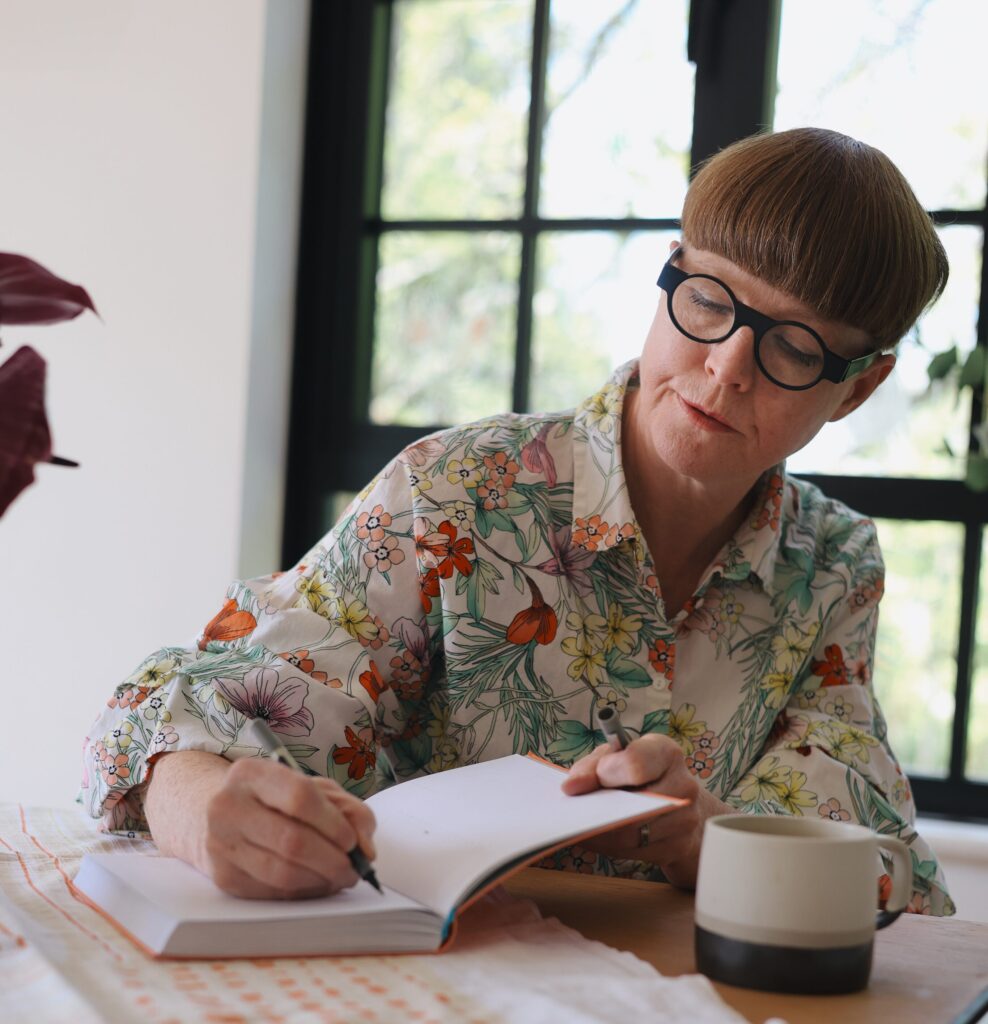
Most of our time together is simply spent with you telling me about your person. There’s nothing to prepare. I have a few prompts to begin, and once we start, one memory tends to lead into the next. People often surprise themselves with what they remember.
I’m listening for the essence of who someone was: the phrase they always used, the hobby they never gave up, their perfect day, the thing that made everyone roll their eyes, the thing they were proud of. It’s these small specifics that let me create a ceremony that is unmistakably theirs.
What happens after the meeting
Once I’m home, I write up an outline of the ceremony and send it to you to approve or adjust. I also send a copy to your funeral director, so they can arrange the music, organise any visual tribute or webcast, and confirm the running order with the crematorium or burial ground.
In that first email, I include any deadlines for written contributions, and let you know when to expect a full draft of the script. I’ll always give you a couple of clear days to review it, because I want you to be happy with every single word.
How much does a funeral celebrant cost?
Families usually pay the celebrant separately from the funeral director, with the fee added to the overall funeral invoice. Independent celebrant fees typically range from around £250 to £600, depending on the celebrant’s experience, your location, and the length of the ceremony.
Your funeral director will always be open with you about costs from the very start, and can talk you through what’s included.
What this meeting is really for
My hope, with every funeral meeting, is to make it a safe space for families to talk freely about the person that’s died. Most people find it cathartic, and there’s usually laughter alongside the tears, sometimes within the very same sentence.
It’s a real privilege to support people at such a tender time, and to help shape a ceremony that reflects who someone truly was.