

When someone close to you dies, the next steps aren’t always immediately clear.
That’s when experience is more valuable than ever.
Planning a funeral will be different for every family. Funerals can be as simple or as elaborate as you desire. Some people choose a small, family gathering at a local venue. Others prefer a grand affair. Either way, we believe that the most meaningful ceremonies are those which reflect the person’s life and preferences.
We’ll talk you through all the steps needed to plan a funeral, from what to do when someone dies to arranging a meaningful service. Our Planning Checklist is available for you so absolutely nothing is missed.
What do I do immediately after someone dies?
First, take a breath.
If the death was expected and you’re at home, you can sit with the person for as long as you need to. Nothing needs to happen within the hour.
When you’re ready, what to do next depends on where the death happened. The process is slightly different if a death occurs at a hospital or at home/in a care home. If at home and expected, call the GP during surgery hours or NHS 111 out of hours, and they’ll send someone to confirm the death. In a hospital, the staff will guide you through what happens next, so you don’t need to chase anything.
Once the death has been confirmed, you can call a funeral director whenever you’re ready. We’ll bring the person into our care at any time of day or night, and the paperwork will work its way to you over the following days.
In our experience, the families who do best in the first few hours are the ones who allow themselves to do very little.
Navigating the first steps when someone has died
At this difficult time, there are some processes and paperwork that will take place. You can rest assured that you don’t have to do any of this in a hurry, and you won’t be doing it alone.
- The death is verified. A doctor, paramedic, or qualified nurse confirms the person has died. In a hospital, hospice, or care home, staff do this. At home, it’s usually a GP or emergency services.
- A medical examiner reviews the cause of death. All deaths that aren’t investigated by a coroner are independently scrutinised by an NHS medical examiner. The medical examiner’s office will phone the next of kin to talk through the cause of death and answer any questions.
- The Medical Certificate of Cause of Death (MCCD) is sent electronically to the registrar. The family no longer collects a paper certificate.
- You register the death. Once the registrar has the MCCD, you’ll be able to register the death. By law, you must register within five days of being contacted by the medical examiner, unless the case is with a coroner.
- You contact a funeral director. You can do this whenever you’re ready, before or after registration. Most families call us as soon as they feel able to.
- We help you plan the funeral. One decision at a time, at your pace. We’ll explain the service we provide and walk through everything that goes into the day itself.
If you’d like a longer walkthrough, our guide on what to do when someone dies covers more, and our guide to registering a death explains step four in more detail.
Our Service
Our family has been directing funerals since 1690, and throughout the generations, that legacy has taught us that nothing you ask will be unusual, and nothing will be too much trouble. Our funeral planning service covers all aspects of funeral arranging.
We talk to you and guide you on how to choose the format of the funeral, such as if you prefer a burial or a cremation or how to send out invitations. We look at what transportation you require, which coffin would be the best choice, and how to choose music for your loved one. When we meet you, at our welcoming funeral homes, we cover some important topics such as:
Announcing the Death
In most cases, immediate family members announce the death. The news may be shared privately with those closest first. The person who has died may have a list of contacts either in written form or on their mobile phone so that all the important people are notified.
Personalising a Funeral
There are lots of ways to add personal touches to make a funeral unique. We have many years of experience in helping families choose the perfect funeral flowers, design bespoke coffins, select much loved music or choose the most appropriate venue for their funeral wake.
Choosing the date/time of a funeral
Depending on the type of funeral you wish to hold, we will ensure that we plan every detail, ensuring your loved one is cared for at our Funeral Home until the day of the funeral. Funerals typically take place 2 to 3 weeks after a death.
Types of funeral available
Religious, humanist, civil or a woodland burial. There are many types of funeral to choose from, find out more about each of them. Alongside the type, you choose the style. Religious funerals follow the traditions of a specific faith, and we regularly arrange Church of England, Catholic, Muslim, Jewish, Sikh, and Buddhist funerals. For those who can’t be present, a virtual funeral adds a livestream.

Do we have to invite everyone or can it be private?
It’s entirely your choice. A funeral can be wide open to anyone who wants to pay respects, private and invitation-only, or something in between.
A private funeral, sometimes called a family-only funeral, is exactly what it sounds like. You decide who attends, and that’s who comes. Some families hold a private funeral and follow it with a larger memorial service or celebration of life later, which lets everyone who wants to come gather without the pressure of the funeral day itself. Others prefer the opposite, a fully open service where everyone is welcome.
Understanding Funeral Costs
Just as we strive to offer ceremonies for all personalities, so too do we offer services for all budgets. This is part of our philosophy as a family-owned business.
Traditional Funeral
From £4,135

With our tailored funerals, we take the time to fully understand your wishes and requirements and plan a funeral that can be as simple or as intricate as you wish. We appreciate that everyone will have different styles and preferences.
Our funerals are personalised, and suitable for both burials and cremations. Our family ethos extends to our full service, right the way to after the funeral, and we support you every step of the way.
Unattended Funeral
From £2,734

No ceremony funerals are simple and respectful. They are an unattended alternative to traditional services, covering the necessary formalities that leave you and your family the freedom to choose what happens next.
Testimonials
“As a close relative involved in the funeral arrangements I want to express sincere thanks to you and your colleague Emma by setting up and providing such a unique experience and then overseeing a wonderful occasion on the passing of our loved one at her funeral service held in September. Your care and attention to detail was very noticeable as you worked together as a team. Your ability to advise and then manage all the…
“Arranging a funeral for a loved one is fortunately not something the majority of us regularly experience in our lives. However, when the time comes to do so, it is difficult to deal with our own emotions and concentrate on the many aspects of creating a personalised and appropriate funeral to say our final goodbyes. From my first contact with Chris Arnold at Attree & Kent, I felt reassured that I was in capable and…
Attree & Kent, Brighton
“Very many thanks to Jackie for her excellent sympathetic help, nothing was too much trouble and her kindness and patience made, what was a difficult and sad occasion, run beautifully. Many people commented afterwards on how very special everything was. I would happily recommend Deric Scott’s to anyone.”
“My personal review of Peter’s funeral is that it was beautifully managed and the family appreciated the support you gave us. Sarah Hall’s address hit the right balance, for us, between dignity and warmth and we felt that it helped us all to turn that page in our lives and learn to accept that Peter was gone. I would recommend you to anybody who asked.”
Planning a Funeral in Advance
For many people planning a funeral only happens once or twice in their lifetime, Most of our funerals are planned at the time of need.
However, thinking about or planning a funeral in advance can mean that you can share your funeral wishes with those closest to you. This can have several benefits such as easing the emotional burden on your family at a challenging time, arranging payment options in advance, and choosing a funeral director. You can also plan how you would prefer the ceremony to be from music choices, readings, to what you would like people to wear.
Helpful Resources
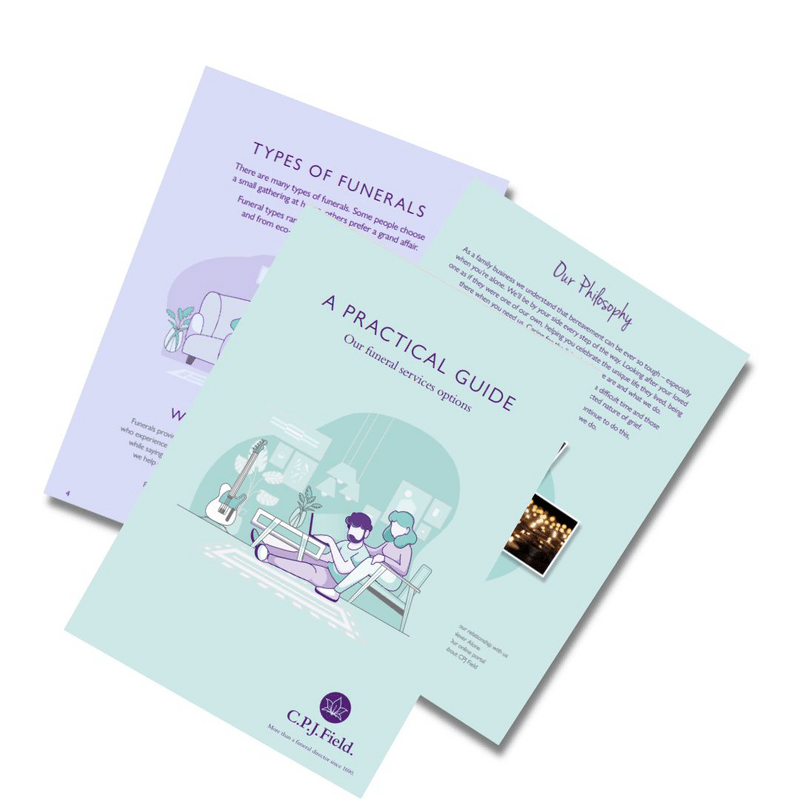
For a practical guide on all aspects of funeral planning, download our handy and informative 24-page brochure for easy reference and advice.
How we'd like to be remembered
A new study commissioned by CPJ Field has revealed that 44% of respondents considered planning their own funeral- this includes 51% of Britons ages sixty and over.

Quick Recap: Planning a Funeral





SHARE